
2 min read
6 min read

Introduction
For a construction company, a reliable work-in-process (WIP) schedule is more than an internal accounting report. It connects construction job costing, project forecasting, financial reporting, and communication with a surety.
A well-prepared WIP schedule helps owners, CFOs, controllers, and project managers understand whether jobs are profitable, whether costs are tracking with expectations, and whether completed work is translating into appropriate billings and cash flow. It can also help a surety evaluate the contractor’s current workload, project performance, and remaining exposure.
However, a WIP schedule prepared for management or surety purposes should not automatically be treated as the company’s final tax calculation. Federal tax rules for many long-term construction contracts require a separate review under Internal Revenue Code (IRC) §460.
What Is a WIP Schedule?
A WIP schedule is a project-by-project report showing the financial status of contracts that are underway but not yet complete. A construction WIP schedule commonly includes:
- Original contract price
- Approved and pending change orders
- Costs incurred to date
- Estimated costs to complete
- Total estimated contract costs
- Percentage of completion
- Revenue earned to date
- Billings to date
- Over-billings or under-billings
- Retainage
- Estimated gross profit or loss
- Projected final profit or loss
- Remaining contract exposure
The schedule is only as reliable as the underlying job-cost information. Construction companies should maintain detailed records supporting contract costs, including contracts, change orders, invoices, payment applications, job reports, subcontractor records, and project documentation.
A WIP schedule should also reconcile to the company’s general ledger, accounts receivable records, contract assets, contract liabilities, and financial statements. Differences may be appropriate depending on the company’s reporting methods, but they should be identified and explained.
|
WIP schedule item |
What it helps management evaluate |
Why it matters in bonding discussions |
|
Costs incurred to date |
Actual progress and spending |
Whether project costs are tracking with the estimate |
|
Estimated costs to complete |
Remaining financial exposure |
Whether the contractor has sufficient capacity to finish the work |
|
Billings to date |
Invoicing and cash-flow timing |
Whether billing practices align with project progress |
|
Retainage |
Amounts billed but not yet collected |
Timing of future cash receipts |
|
Estimated gross profit |
Expected job profitability |
Whether current projects are strengthening or weakening the company |
|
Change orders |
Revised scope and contract value |
Whether the project forecast remains current |
Why Sureties Care About WIP Schedules
Surety bonding decisions are closely connected to a contractor’s financial capacity and project performance. A surety may review WIP information to understand:
- The size and number of active contracts
- The contractor’s backlog
- Whether jobs are generating expected profits
- Whether cost overruns are developing
- Whether projected completion costs are reasonable
- Whether billings and collections are keeping pace with work performed
- Whether the company has sufficient working capital for remaining obligations
A WIP schedule does not guarantee bonding capacity. Instead, it gives the surety a structured way to evaluate the contractor’s current commitments and the risks associated with completing them.
Consistency is particularly important. A company that changes its cost-to-complete assumptions significantly from month to month, fails to record known cost overruns, or reports materially different information to management and its surety may create avoidable concerns.
The surety-facing schedule should generally be prepared using the same underlying job-cost records used for internal financial reporting. If management, the surety, and the tax return each rely on different information, the contractor should be able to explain the differences.
How a WIP Schedule Connects to Contract Profitability
The central purpose of a WIP schedule is to compare project progress with the contractor’s latest estimate of total contract costs.
Common calculations include:
- Estimated cost to complete: Total estimated contract costs minus costs incurred to date
- Estimated gross profit: Contract price minus total estimated contract costs
- Estimated percentage complete: Costs incurred to date divided by estimated total contract costs
- Earned revenue: Contract price multiplied by the estimated percentage complete, subject to the company’s applicable accounting policies
For example, assume a contractor has a $2 million contract, has incurred $800,000 of costs, and currently estimates total costs of $1.6 million. The estimated percentage of completion is 50%, and the estimated gross profit is $400,000.
If the contractor later expects total costs of $1.9 million, estimated gross profit falls to $100,000 even though the contract price has not changed. That change should be reflected promptly in the WIP schedule and investigated by management.
A reliable cost-to-complete report should incorporate known information about:
- Labor productivity
- Material price changes
- Subcontractor performance
- Pending change orders
- Schedule delays
- Rework
- Liquidated damages or other contractual exposure
- Remaining retainage and collection risk
The report should distinguish between approved change orders, pending claims, unapproved work, and amounts that are merely anticipated. These categories may have different effects on project forecasting, financial reporting, and tax accounting.
The Tax Accounting Overlay: IRC §460
For federal income tax purposes, many long-term construction contracts are subject to the percentage-of-completion method. In general, this method recognizes taxable income over the life of the contract based on the relationship between costs incurred and estimated total contract costs.
The tax calculation may not use the same cost pool as a management WIP schedule. Federal tax rules can require specific treatment of direct costs, indirect costs, production-period interest, depreciation-related amounts, and other expenses.
Some construction contracts may qualify for exceptions or alternative methods. Whether an exception applies can depend on factors such as:
- The type of construction contract
- The expected completion period
- The taxpayer’s average annual gross receipts
- Whether the taxpayer is subject to special tax-shelter rules
- The date the contract was entered into
- Whether the taxpayer has made a valid accounting method election
A construction company should therefore view its WIP schedule as an important source of information for tax preparation—not necessarily as the final tax workpaper.
Plain-Language IRC §460 Disclaimer
IRC §460 is the federal tax rule that governs how many long-term construction contracts report income and costs. The percentage used for management reporting or surety bonding is not automatically the same percentage used to calculate taxable income.
Contract type, estimated completion date, cost classifications, gross receipts, accounting method elections, and other facts can affect the tax result. This article provides general educational information and is not individualized tax advice. A contractor should have its CPA or tax adviser review the applicable contracts, accounting methods, and current tax rules before filing a return or changing how contract income is reported.
Why the WIP Percentage May Differ From the Tax Percentage
A company’s management or surety percentage of completion may differ from the percentage used for federal tax purposes for several reasons.
Different Cost Definitions
Management may include or exclude certain costs based on financial reporting policies, while IRC §460 may require specific treatment of direct costs, indirect costs, production-period interest, or depreciation-related amounts.
Different Contract Scope
A single agreement may need to be evaluated separately from related agreements, or multiple agreements may need to be considered together for tax purposes. The appropriate treatment depends on the facts and economic relationship among the agreements.
Different Completion Dates
The date a project is considered complete for operational, financial reporting, contractual, or tax purposes may not be the same. For example, customer use, substantial completion, final acceptance, retainage, and remaining punch-list work may each affect how completion is evaluated.
Special Tax Elections
Certain taxpayers may be eligible to make elections that affect when contract income and costs are recognized. These elections can have broad application and should be reviewed before they are made.
Contract Exceptions
Some construction contracts may qualify for exceptions to the regular percentage-of-completion rules. The eligibility requirements and effective dates can change, so the applicable rules should be confirmed for the specific contract and tax year.
Surety Bonding, Common Improvements, and Completion
Construction projects sometimes include common improvements, site work, roads, utilities, or other items that benefit multiple properties or contracts. Those costs should be assigned consistently and supported by a reasonable allocation method.
A contractor’s treatment of shared costs can affect both project profitability and the estimated cost to complete. Unsupported allocations can make a WIP schedule less useful to management and less persuasive to a surety.
Completion also matters because it can affect:
- The timing of final profit recognition
- Final billing and collections
- Remaining retainage
- Contract closeout
- Look-back calculations for certain tax methods
- The surety’s assessment of remaining exposure
After a contract subject to the percentage-of-completion method is completed, federal tax rules may require a comparison between income previously reported using estimates and the income that would have been reported using actual contract results. This process is commonly referred to as a look-back calculation.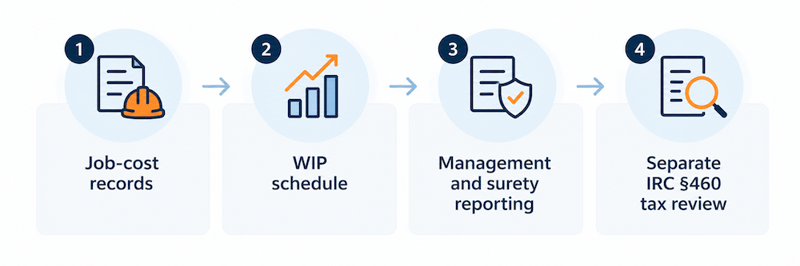
Common WIP and Bonding Mistakes
Construction companies should watch for several recurring problems:
- Using outdated cost-to-complete estimates
- Failing to record known losses promptly
- Treating pending change orders as approved contract value
- Omitting retainage from collection forecasts
- Reporting WIP figures that do not reconcile to the general ledger
- Using unsupported percentages for labor, materials, or subcontractor completion
- Failing to separate project costs from general overhead
- Mixing financial-reporting, surety, and tax calculations without documenting the differences
- Failing to review the tax treatment when a contract changes scope or completion timing
- Providing the surety with a schedule that does not reflect known project problems
A construction CPA can help document why management WIP, financial-reporting WIP, and taxable income may not be identical.
Practical Records to Maintain
A contractor should maintain organized records for each significant project, including:
- Original contracts and amendments
- Approved and pending change orders
- Subcontracts and purchase orders
- Job-cost reports
- Labor and equipment records
- Vendor invoices
- Subcontractor payment applications
- Billing records and retainage schedules
- Cost-to-complete analyses
- Project schedules and progress reports
- Records supporting claims, disputes, and back charges
- General-ledger reconciliations
- Tax work papers supporting the applicable accounting method
- Documentation of accounting method elections
- Records supporting contract completion and acceptance
Strong documentation helps management make better decisions and allows the company to explain its estimates to lenders, sureties, auditors, and tax advisers.
When Should a Contractor Talk to a CPA?
A contractor may benefit from CPA guidance when:
- The company is preparing its first formal WIP schedule
- Project margins are changing significantly
- A contract is experiencing cost overruns or delays
- The company is applying for larger performance bonds
- The contractor is considering a new accounting method
- The company has multiple types of construction contracts
- Management WIP results differ from the tax return
- The business is approaching a size or complexity threshold that may affect tax treatment
- The company needs to reconcile job-cost reports to financial statements
For Triangle-area contractors, coordinating construction accounting, surety reporting, and tax planning can help create a more consistent financial reporting process.
Conclusion
An accurate WIP schedule and surety bonding process can help construction companies understand project profitability, identify cost overruns, forecast remaining cash needs, communicate with sureties, and support reliable financial reporting.
The schedule should also be treated as a starting point for tax analysis—not a substitute for reviewing the applicable rules under IRC §460 and related federal guidance. Stancil CPA can help Raleigh-area and Triangle contractors organize job-cost information, reconcile WIP reporting, and evaluate related accounting and tax considerations. Schedule a consultation to discuss your construction company’s reporting and tax-planning needs.

5 min read
How to Improve Revenue Cycle Management in Healthcare
Introduction As a healthcare practice or organization grows, its revenue cycle can become more difficult to manage. More patients, providers,...

5 min read
S Corporation Tax Planning for Business Owners
Choosing how your business is taxed is an important decision. For some business owners, S corporation tax treatment may reduce employment-tax...